
How much do glass splashbacks cost?
Real price bands, what actually moves the number, and the extras that should never appear on a quote.
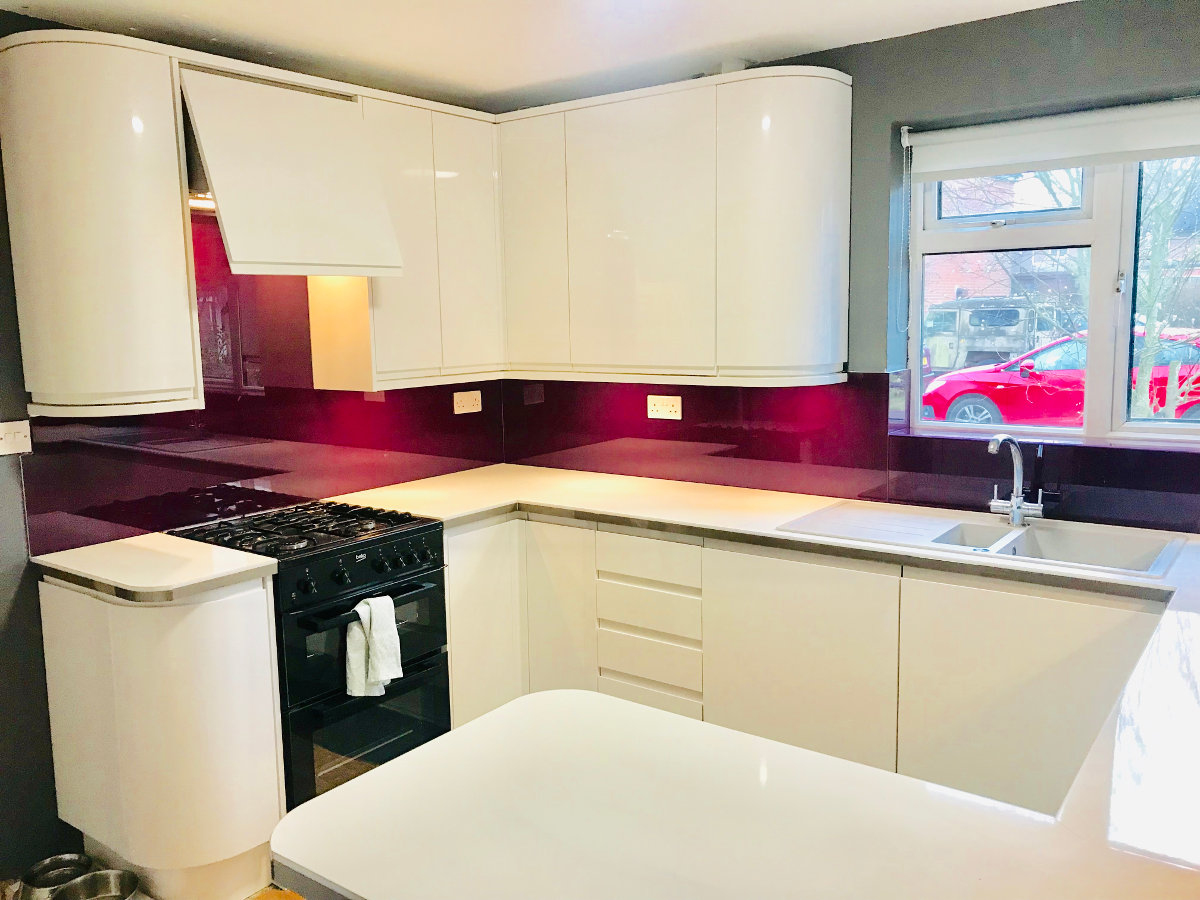
The most common question we get asked about glass splashbacks is: how much? The honest answer is "it depends on the colour, the size and the finish", but that is not very useful, so here is a breakdown that should help you budget.
These are our own supplied-and-fitted figures for Sussex, not national averages scraped from a directory. Prices elsewhere in the country will differ, and anyone quoting a single fixed price without seeing the wall is guessing.
The headline ranges
- Single panel behind a hob (around 900mm × 600mm): £180–£420 supplied and fitted
- Full kitchen run between worktop and wall units (around 3m total): £450–£900
- Feature wall behind a bath or basin: £350–£700
- Full back wall, priced per square metre: £180–£360 per sqm
The spread within each band is wide because two jobs of identical size can be very different amounts of work. What follows is what moves you from the bottom of a band to the top.
What drives the price
1. Size
The bigger the panel, the more glass and the more paint. Large panels also need more careful template, manufacture and install, a 3m run is materially more work than a 1.5m run.
There is also a practical ceiling. Toughening furnaces have a maximum bed size, and beyond roughly 2.4m a run has to be split into multiple panels with a joint. A joint is not a problem, it is a design decision, but it is worth agreeing where it falls rather than discovering it on fitting day. We usually put it behind a hob upstand or in line with a cabinet edge so it reads as deliberate.
2. Colour and finish
A standard RAL or Pantone colour is the cheapest option. Special finishes, metallic, sparkle, mirror, satin, cost more because the paint and the application process are different. Expect a 15–30% premium for a metallic or sparkle.
One thing worth knowing before you fall in love with a colour: the paint goes on the back of the glass and you view it through the glass. That means the finished colour is always slightly affected by the glass itself, which brings us to the next point.
3. Glass type
Standard float toughened is the default. Low iron toughened, recommended for whites, pale colours and pastels, adds about 15%. The reason is that float glass has a slight green tint that mutes light colours.
In practice: a black, navy, dark grey or deep red splashback in standard float will look exactly as you expect, and paying extra for low iron is money wasted. A white, cream, pale grey, duck egg or pastel splashback in standard float will come out looking faintly green, and people are genuinely disappointed by it. If your colour is pale, treat low iron as essential rather than an upgrade. Our guide to glass types explains the difference.
4. Cut-outs and complexity
Cut-outs for sockets, switches and pipework are part of the template stage. Each cut-out adds a small amount to the price because it has to be marked, cut, polished and re-toughened.
Worth understanding why that sequence matters: toughened glass cannot be cut, drilled or modified after toughening. Every hole and every edge has to be finished first, then the panel goes through the furnace. Which means a socket in the wrong place on the template is not a small fix. It is a new panel. This is the single strongest argument for having the job templated rather than working from your own measurements, and it is why we template every splashback.
5. Returns and mitres
A panel that turns a corner needs either two panels butted together, or a mitred joint. Mitres are cut and polished by hand and add cost, but they give a much cleaner corner with no visible vertical joint line. On a peninsula or a window reveal this is usually worth paying for.
6. Access and install
A ground-floor kitchen with a clear run from van to door is the easy case. A second-floor flat with no lift adds time. We will tell you on the quote if access affects the figure.
Large panels are heavy and awkward. A 2.4m toughened panel is a genuine two-person lift and sometimes three, and it does not bend around a tight stair turn. If your kitchen is up a narrow Victorian staircase in Hove, we will look at the route at survey and may recommend splitting the run.
Timing: when to order
Order the splashback after the units and worktop are in, not before. The template has to be taken off the finished installation, because worktops are rarely dead level and wall units are rarely dead parallel to them. Templating off a drawing or off bare walls produces a panel that does not fit.
Allow around two to three weeks from template to fit for a bespoke coloured panel. If you have a kitchen fitter working to a deadline, tell us the date at survey and we will tell you honestly whether it works.
Glass against the alternatives
For context on the numbers above: acrylic splashbacks are cheaper but scratch, and they can discolour or distort behind a hob. Tiles are cheaper in material but the labour and the grout are the real cost, and grout behind a hob is a cleaning job forever. Stainless steel is durable and industrial-looking but shows every fingerprint. Glass sits in the middle on price, has no joints to clean, is heat resistant behind a hob when toughened, and comes in any colour you like.
We would not tell you glass is always the right answer. If you want a patterned or textured wall, tiles do things glass cannot.
How a Brooklands quote breaks down
Most of our quotes show three lines: glass and template, paint and finish, fitting. That way you can see exactly what you are paying for. We do not bury labour in the materials line, and we do not pretend the paint is free.
What you do not need to pay for
- The survey and template visit, free in our regular service area.
- "Design fees", we do not charge for these.
- Removal of the old splashback, included in any retrofit job.
If a quote from anyone includes a separate design fee or a charge for templating, ask what it is for.
Want a quote? Visit our glass splashback service page or request a free quote.
Have a project we can help with?
Tell us what you are thinking and we will reply within one working day.